By Basant El-Faramawy
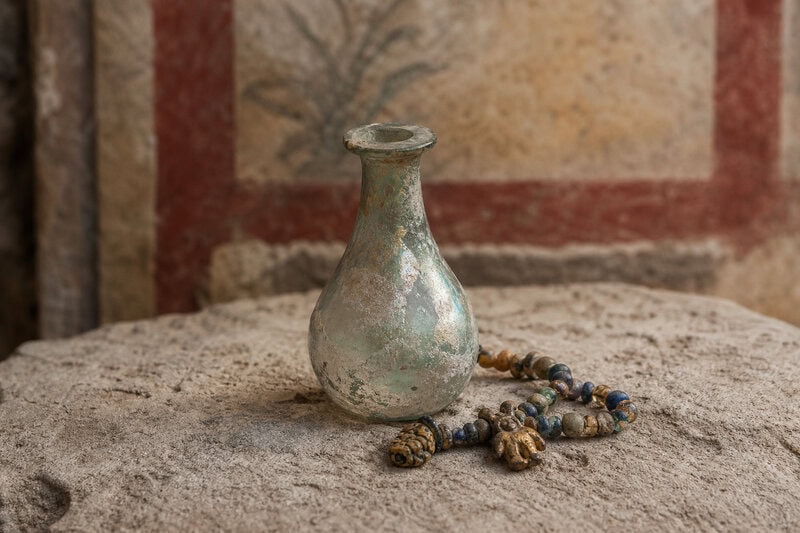
Archaeologists have uncovered a unique 2,000-year-old perfume bottle from a wardrobe in the ruins of Pompeii, the ancient city buried by the eruption of Mount Vesuvius in 79 AD.
Discovery at Regio IX
The wardrobe was discovered at Regio IX, Insula 11, an archaeological site about 44 meters long that was excavated mainly between 1911 and 1912. It contained other artifacts including cosmetics, lead weights, 38 bronze coins, and a necklace of children's amulets, researchers reveal in E-Journal degli Scavi di Pompei.
Significance of the Find
The latest find could throw more light on the daily practices and material culture of the city before the Vesuvian eruption. So far, excavations at Pompeii over centuries have unravelled nearly two-thirds of the ancient city, revealing insights about the lives of ancient Romans during the time.
House of Cornelius Maximus
The furniture was found at the back of a house seemingly attributed to a man called Cornelius Maximus, though the exact inscriptions could no longer be seen. The house overlooked Via dell'Abbondanza, one of the main road axes of the ancient city. A dining room had a lime floor with fragments of white stone from the 2nd century BC, and the house appeared to have been under renovation when the volcano erupted, evidenced by a bare plaster ceiling and a window cut after the fact.
Reconstruction and Artifacts
Researchers rebuilt the wardrobe from its imprints after its shelves collapsed when the room's ceiling gave way. Half of the wardrobe was buried while the remaining part survived. Artifacts found at the site included fragments of everyday pottery, cooking pots, a cup decorated with pine cone-like scales, and the base of a glass dish.
Personal Items and Cosmetics
A tiny charm shaped like a shoe with wings was also found, likely part of a necklace given to children. Other tiny fragments of ceramic, glass, bone, and crystal may have also been part of the charm necklace. The wardrobe contained a glass perfume bottle, a small slate slab used for grinding pigments, tweezers, a pigment grinder (coticula), a glass balsamarium, a perfume burner, and a bronze lantern — together resembling a makeup palette of the era. Small lead weights placed in a wooden box were also recovered; they seem compatible with commercial activities but their specific function remains a mystery.