By Basant El-Faramawy
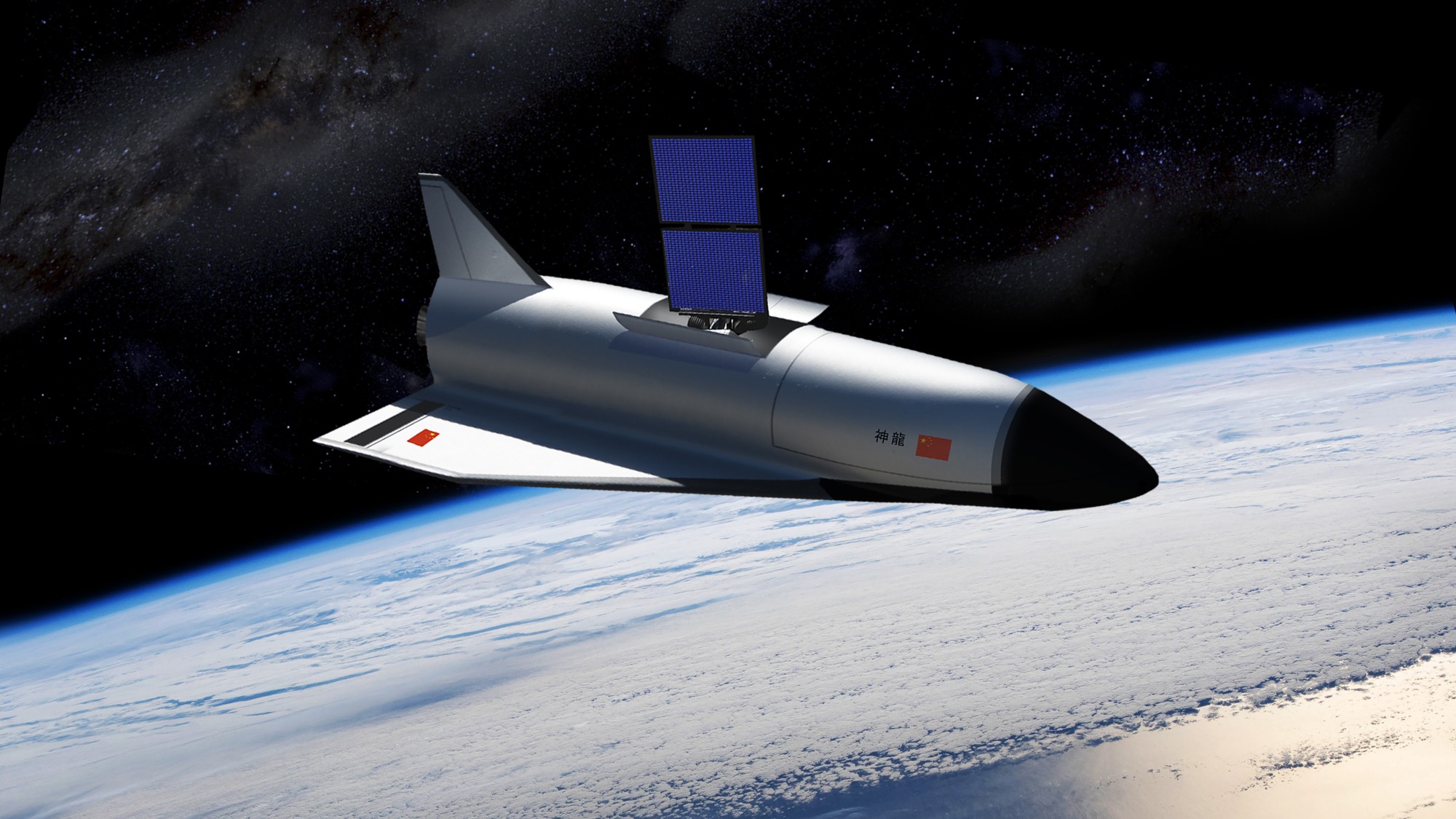
The US has declassified an image of China's Shenlong space plane, captured by a commercial satellite in 2024, as part of a new Pentagon report on space threats. The full-resolution photograph, taken by the American firm Vantor (formerly Maxar), shows a winged, uncrewed vehicle that resembles the US Space Force's secretive X-37B space plane.
Shenlong space plane details
The image reveals payload bay doors suggesting the craft can store and deploy small satellites or other spacecraft. Shenlong has flown four known orbital missions since 2020, with the most recent launching in February 2026; flights typically last around nine months. According to the Defense Intelligence Agency report, in November 2022 the space plane maneuvered with a companion satellite, maintaining station-keeping at roughly one kilometre separation and at one point closing to within 100 metres, possibly rendezvousing before the satellite was re-released.
Space weapons development
The report also details China's development of space weapons, including directed-energy weapons that use lasers or concentrated particle beams to disable targets. The DIA states China has developed and will likely continue developing weapons for use against satellites to disrupt, damage, or destroy adversary space capabilities, aiming to become the preeminent leader in space and shape international norms. There is no evidence that the Shenlong spacecraft itself carries space weapons.
Russia's nuclear satellite
Other potential adversaries named in the report include Russia, which is reportedly developing a satellite designed to carry a nuclear weapon. Such a capability could cause rapid loss or degradation of thousands of satellites worldwide, affecting communications, navigation, scientific, meteorological, commercial, and national security services. A nuclear detonation at sufficiently low altitude could also interrupt power grids globally.
Arms race concerns
The 1967 Outer Space Treaty, signed by the UK, US, and USSR, prohibits placing nuclear weapons in orbit. There is currently no internationally agreed system for managing military activities in space, though several countries, including China and Russia, are pushing for rules to prevent a global arms race. The DIA report claims the proposed treaties from China and Russia refuse to acknowledge ongoing efforts to develop and deploy space weapons.