By Salma El-Sakka
An ancient Chinese chronicle of a solar eclipse in 709 BC has revealed new details about how Earth's rotation has changed over thousands of years.
Historical Record Corrected
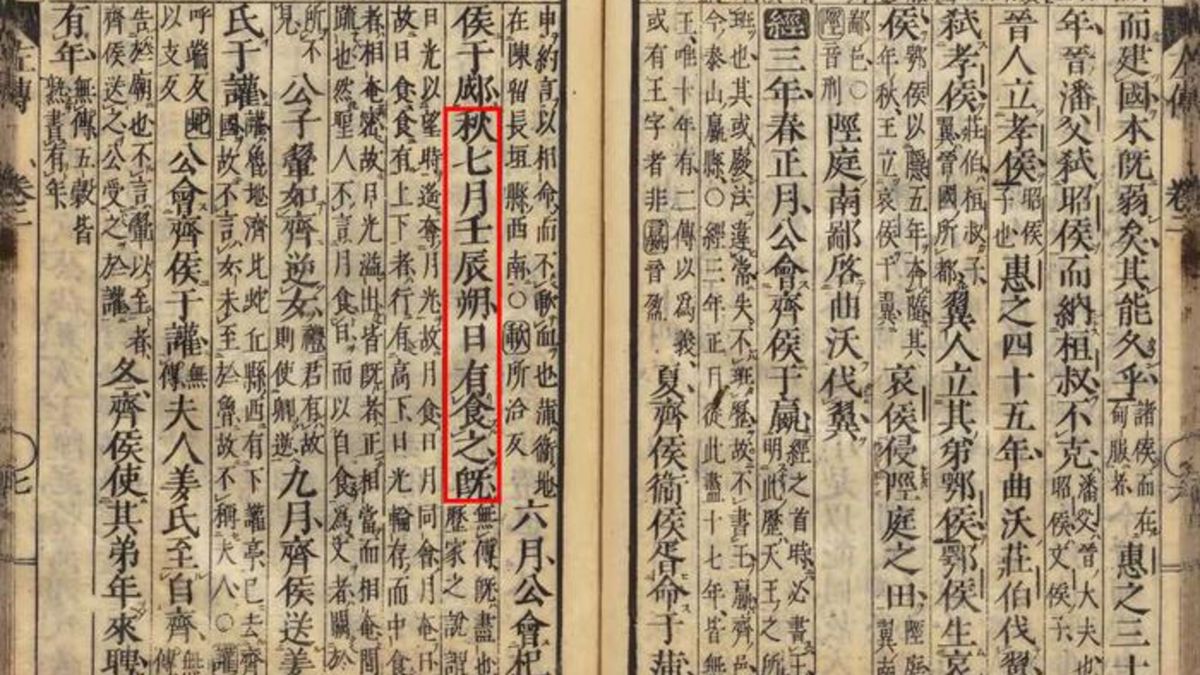
The eclipse, observed on 17 July 709 BC, was recorded in the "Spring and Autumn Annals", a chronicle compiled centuries later. Observers at the court of the Lu Duchy, a vassal state during the Zhou dynasty, noted that the Sun was totally eclipsed.
Earth does not rotate at a constant rate. The planet's rotation 2,700 years ago was faster than today, and its spin has gradually slowed, partly due to ocean tides generated by the Moon's gravitational pull.
Previous astronomical calculations based on earlier estimates of Earth's rotation indicated that a total eclipse should not have been visible from the ancient Chinese court. Researchers have now corrected a geographical error using archaeological data, allowing a more accurate reconstruction of the eclipse's path.
Insights into Solar Activity
Scientists from Nagoya University and the National Astronomical Observatory of Japan say the correction enables precise measurement of Earth's rotation during the eclipse, calculation of the Sun's rotation axis orientation, and simulation of the corona's appearance. The study is published in The Astrophysical Journal Letters.
A later record in the "Hanshu" (Book of Han), made seven centuries later, contains a passage that may describe the solar corona. If confirmed, it would represent one of the earliest surviving written descriptions of the corona, suggesting the Sun was near the peak of its approximately 11-year activity cycle at the time.
The findings underscore the importance of astronomy in ancient China, where successive dynasties employed specialists to monitor celestial events that were often interpreted as omens.