By Sohaib Shams
UK house prices recorded their biggest annual fall in three years in October, according to Lloyds Banking Group. The average property value fell 1.2% year-on-year, the steepest decline since October 2023, with the average price at £296,285, down £1,882 or 0.6% from September.
Economic pressures weigh on demand
Andrew Asaam, mortgages director at Lloyds, said housing demand is being tested by a challenging economic backdrop. Renewed inflationary pressures, driven partly by the conflict in the Middle East, are keeping borrowing costs high and squeezing household finances, making buyers more cautious. However, Asaam noted that house prices have changed relatively little over the past couple of years as the market adjusted to higher interest rates, and the recent rise in energy and other household costs has added to pressure on buyers.
Bank of England rate rise adds to squeeze
On Thursday, the Bank of England raised its base rate by 0.25 percentage points to 4%, the first increase in more than three years. UK Finance said the increase would add £30.72 on average to monthly payments for homeowners on tracker deals. Around 87% of outstanding homeowner mortgages are fixed rates, but 2.3 million fixed-rate deals are due to expire in 2027.
Experts warn of subdued market
Nathan Emerson, chief executive of Propertymark, said renewed inflationary concerns and the base rate rise will continue to weigh on consumer confidence. Karen Noye, a mortgage expert at Quilter, described the market as “running up the down escalator,” with buyers finding every step harder. Mark Harris, chief executive of SPF Private Clients, said the rate rise may focus the minds of those remortgaging, suggesting shorter fixed-rate deals and extended mortgage terms as options. David Hollingworth, associate director at L&C Mortgages, said the price drop will not cheer homeowners and subdued house price inflation looks likely to continue, noting mortgage rates have risen substantially since the outbreak of the Iran war. Iain McKenzie, chief executive of The Guild of Property Professionals, said the figures should serve as a wake-up call for sellers still pricing homes at market peaks. Sarah Coles, head of personal finance at AJ Bell, said higher mortgage rates, a glut of homes, and a dearth of buyers have taken their toll, with variable rates vulnerable to further rises heading into 2027.
Regional price variations
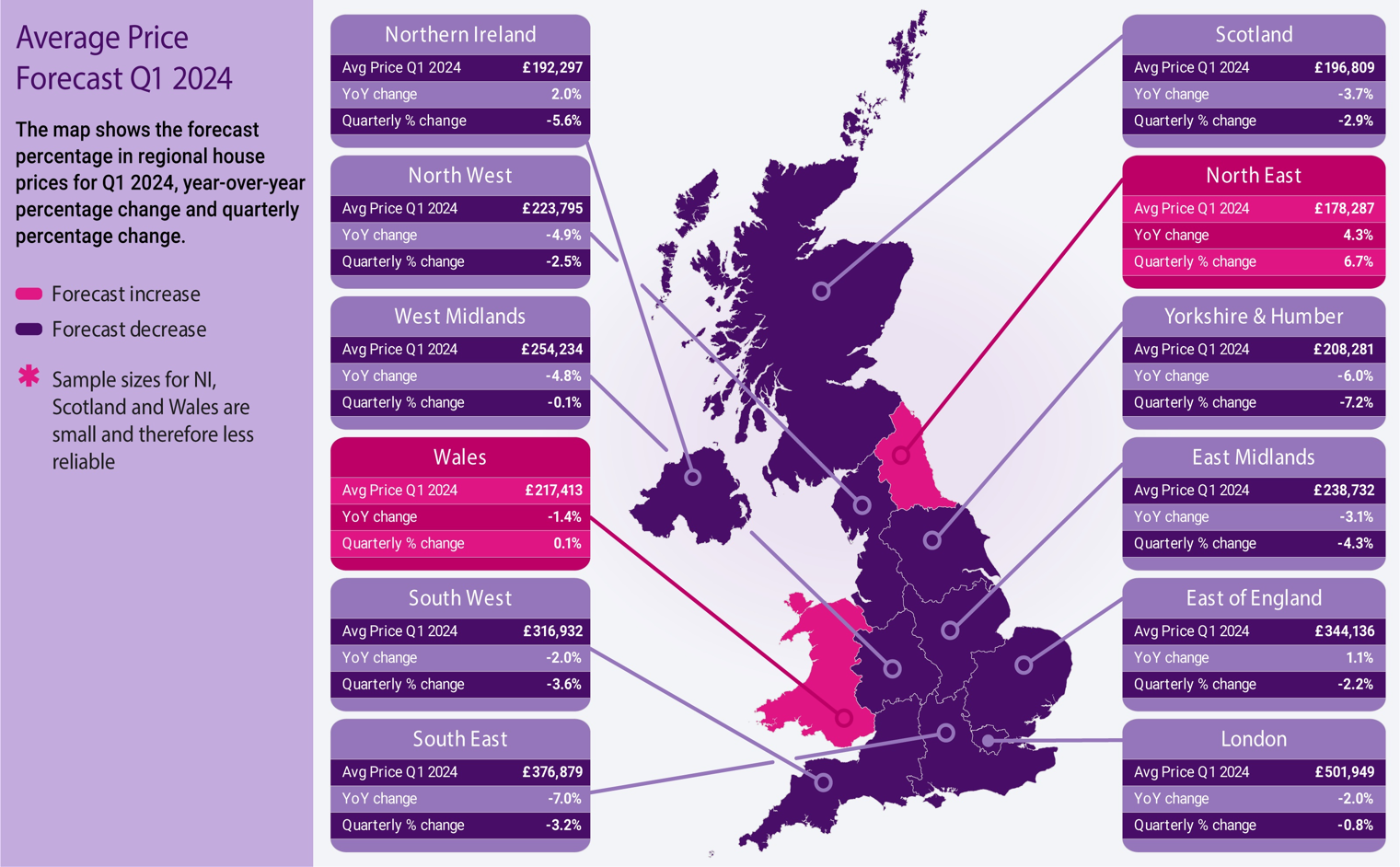
Lloyds data showed annual price changes varied across regions. London saw the largest annual decline at 3.1%, with the average price at £524,892. The South East and South West both fell 2.4%, while Eastern England dropped 2.3%. Yorkshire and the Humber fell 1.0%, and the East Midlands slipped 0.3%. In contrast, Northern Ireland rose 4.4%, the North West 2.2%, Scotland 2.8%, the North East 2.0%, Wales 1.6%, and the West Midlands 0.3%.