By Fatma Younis
Satellite radar surveys have revealed a massive 2,600-year-old complex buried beneath the Nile at the ancient Egyptian city of Buto, also known as Tell el-Fara'in.
Advanced Technology Penetrates Deep Layers
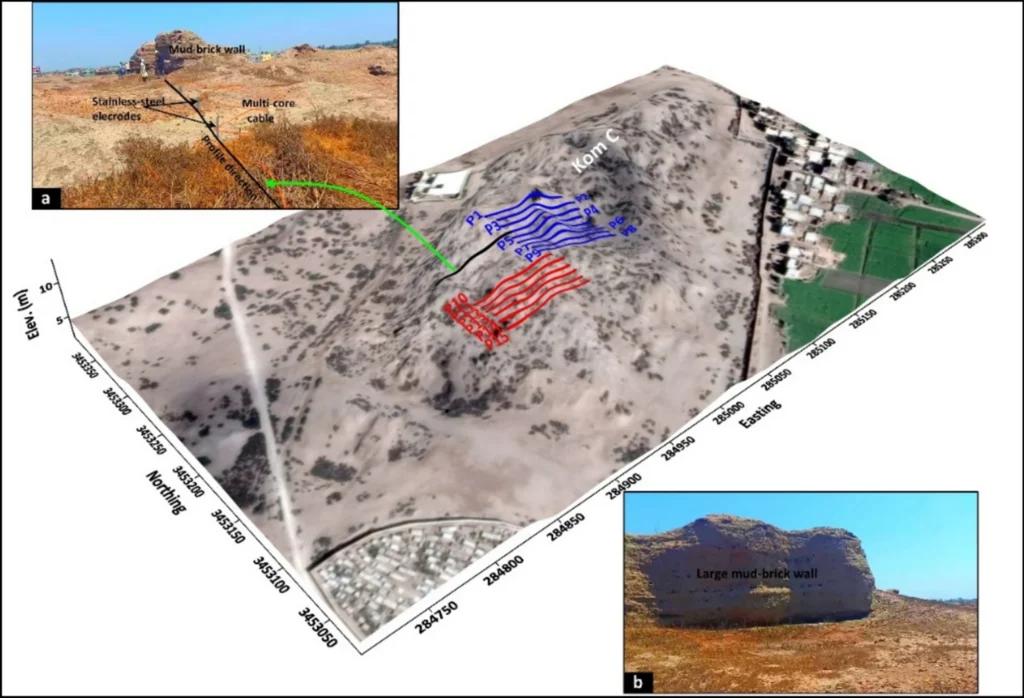
Researchers used Sentinel-1 satellite radar data combined with electrical resistivity tomography to detect structures buried under thick mud deposits and later ruins. The satellite constellation, launched between 2014 and 2025, identified large-scale anomalies near the Nile.
Saite Period Structure and Sand Foundation
At depths of three to six meters, the technology uncovered a well-defined mudbrick structure from the Saite period, possibly a large tomb or shrine. Below that, a thick layer of clean sand appears to have been deliberately packed as a load-distributing foundation, similar to modern engineering techniques.
Excavations Confirm Predictions
Test excavations over a 100-square-meter area revealed mudbrick walls and religious artifacts exactly where sensors had predicted. The study, published in Acta Geophysica, highlights the effectiveness of combining remote sensing with geophysical measurements for mapping buried settlements.
Potential for More Discoveries
Researchers believe another temple may lie buried under a thick clay layer and plan to expand surveys with larger equipment to reach deeper, older levels.